

The Architect’s Guide: How to pay off debt fast

Updated: Mar 27
I remember waking up at 3:00 AM with my chest tight, staring up at a ceiling that suddenly felt very low. You spend hours searching online for "how to pay off debt fast," hoping for a magic bullet that will change your reality before the next payment is due. But while you are searching for immediate relief, the invisible thief of interest is steadily dismantling your foundation, thriving on your panic and your tunnel vision.
When you are trapped in that 14-day cycle of anxiety, every expense feels like a structural failure.
Structural Debt: Why Traditional Debt Payoff Strategies Collapse
When I was $30,000 in debt at age 24, I tried everything. I read the standard blogs and tried the generic "envelope methods." I’d pay an extra $100 here and there, feel a momentary high of accomplishment, and then get hit with a rent increase and a monthly Public Transit Pass increase.
The result? I’d end up putting that $100 right back onto the credit card to survive the increased monthly living expenses, then go out for beers to "feel good" and "forget" the stressful week, because I "deserved it."
It’s a vicious cycle of instability. Generic debt payoff strategies fail because they are designed for an "average monthly budget"—a mathematical illusion that doesn't exist in the real world of bi-weekly paychecks. To truly find the fastest way to pay off debt, you must stop thinking like a prisoner of monthly income and start thinking like an Architect in a 12-month cycle.
Reclaiming Your Life-Force to Fund the Demolition
You don’t need a rigid budget; you need a blueprint. A budget tells you what you should have done. A blueprint—specifically, a 12-Month Forecast Engine—shows you where every dollar of your "life-force" is going before you ever spend it.
Image: A partial screenshot example of The 12-Month Forecast Engine live and in action.

To accelerate the build toward freedom, you must execute two tactical maneuvers:
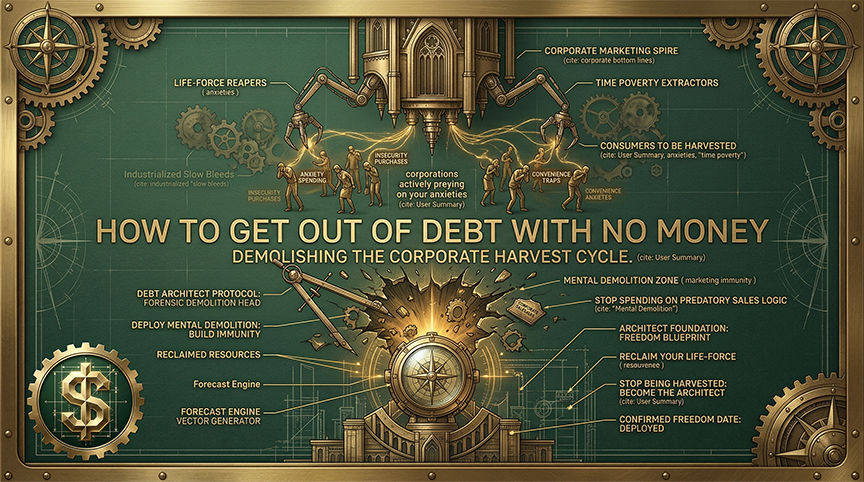
Seal the Leaks: You cannot rebuild a structure with a cracked foundation. You must stop the slow bleed of marketing impulses, convenience fees, and high-interest debt that preys on your paycheck-to-paycheck tunnel vision.
Plan the 'Debt Strike': In Canada, most people paid bi-weekly receive three paychecks in two specific months of the year. The Tunnel Vision Financial Prison sees this as "bonus money" for consumption. The Architect sees this as a precision charge designed to demolish a debt.
By visualizing your next 12 months with absolute clarity, you can pinpoint the exact moment your reservoir has the capacity to absorb a major payment months in advance without leaving you exposed to a structural collapse the following week.
Visualizing the Build: Monthly Average vs. Bi-Weekly Reality
Let's say your Net Income is $12,000/year, and you have $900/month in expenses. The Monthly Average Income is an illusion of what you have to spend because you are paid every 14 days, not "twice a month", but your bills are charged "monthly", not every 28 days.
You don't have $1000/month (12,000 / 12) with $100 left over, you have $922 every 14 days (12,000 / 26 "14 day" periods) and only $22 left over. This means for 9-10 months of the year, you actually only have $922, but those other 2 months where 3 paydays happen to fall within a month, you have $1383 income.
This is the power of clarity. Most people look at the top section—the "Theoretical Blueprint"—and assume they always have a $100 surplus. When they apply a "debt payoff strategy" to that $100, the reality of the bottom section (where the bi-weekly income drops for 10 months) causes them to crash and fail.

A blueprint must respect the actual flow of materials (cash), not the theoretical monthly average.]
By viewing the 12-month structural build, you can see that January and August are the opportune times to execute a "Debt Strike." You are using your real numbers, not an average, to fund the demolition.
To pay off debt fast, Use My Professional Financial Blueprint
Many people spend years searching for generic credit card debt relief or consolidation programs that often just treat the symptom, hurt their credit, and leave the underlying structural issues intact.
The Debt Architect: Blueprint to Freedom course gives you the professional tools to act as your own structural engineer. Instead of guessing, you will deploy the exact Forecast Engine shown above.
You will use your real bi-weekly numbers to pinpoint your actual Freedom Date.
You don't need a quick fix. You need the heavy machinery. The fog has lifted. The site is cleared. It’s time to stop guessing and start building.


Comments