

Hotel Hero Rewards Program
A Cultural Currency System for Staff Engagement & Retention
It usually doesn’t look broken at first...

Operations are running.
Shifts are covered.
Guests are being served.
On paper,
everything is functioning.
But underneath that... something feels off.
Staff don’t engage unless they have to.
Recognition feels inconsistent.
The same people carry the culture, while others remain disconnected.
Initiatives get introduced, but nothing really sticks.
Over time, even well-intentioned efforts start to feel performative;
something employees participate in out of obligation, not belief.
And eventually, whether it’s said out loud or not,
a quiet assumption takes hold:
“This won’t change anything.”

Initial observation and internal feedback revealed a deeper issue than low engagement.
It wasn’t that efforts didn’t exist, it was that they lacked continuity, ownership, and trust.
Engagement was largely driven by management-led initiatives.
Events were chosen top-down...
Activities were decided in isolation...
Participation was expected, not earned...
Over time, frequent leadership turnover reinforced the pattern... new ideas would be introduced, then abandoned, then replaced again.
Nothing lasted long enough to build belief.
The Result: A growing disconnect between effort and impact.
Staff didn’t disengage because they didn’t care, they disengaged because the system felt inconsistent, controlled, and ultimately out of their hands.
The Hotel Hero Rewards Program
was designed around a simple premise:
If the behaviors that build a strong workplace are valuable,
they should function like value.
Not abstractly... but structurally.
Staff earn points through actions that contribute to culture, not just performance.
Recognition, participation, initiative, development... each one becomes measurable, visible, and rewarded.
These actions are intentionally separated from core job responsibilities.
They exist in a different category:
Not what’s expected—but what elevates the environment.
Over time, this creates a shift.
Engagement is no longer something encouraged occasionally...
It becomes something that accumulates.

Example from a real-life system
in use at a hotel I worked at.
Earning Points
Other points categories include:
-
Participation & Engagement
-
Challenges and Games
-
Personal Development
-
Cultural Impact
The structure allows staff to self-direct how they engage.
Some participate casually through weekly challenges.
Others engage more deeply through events, recognition, or development.
But the outcome is the same:
Contribution becomes visible.
And visibility drives momentum.
THE
POWER UP
LUNCHEON
& REDEMPTION DAY
At the center of the system is a single, recurring moment each quarter: The Power Up Luncheon.
This is where the system becomes tangible.
Points are redeemed.
The “Hotel Hero” is recognized.
Birthdays, milestones, and contributions are celebrated collectively.
What has been building quietly over weeks becomes visible in a single, shared experience.
The structure matters.
Rather than continuous, low-visibility rewards, the system consolidates recognition into a defined moment. This creates anticipation, reinforces value, and allows engagement to accumulate toward something meaningful.
Even within strict operational constraints such as: limited time windows or scheduling limitations, the Power Up Luncheon anchors the system.
It’s not just a reward cycle.
It’s a cultural checkpoint.
For a system like this to work, it can’t live in the background.
It has to be seen.
That’s where the second component comes in: The Hub.

A centralized, physical space designed to make engagement tangible.
Not a bulletin board.
Not static communication.
An active environment.
Recognition is posted in real time.
Challenges rotate weekly.
Leaderboards are visible.
Staff contributions are surfaced continuously.
It becomes part of the daily rhythm.
Not something separate from it.

Something simple begins to happen.
People stop wondering if engagement matters.
They can see it.
They can see who’s participating.
Who’s being recognized.
What’s happening.
And more importantly...
They can see where they fit into it.
Once engagement becomes visible, it needs to lead somewhere.
That’s where the reward system comes in.
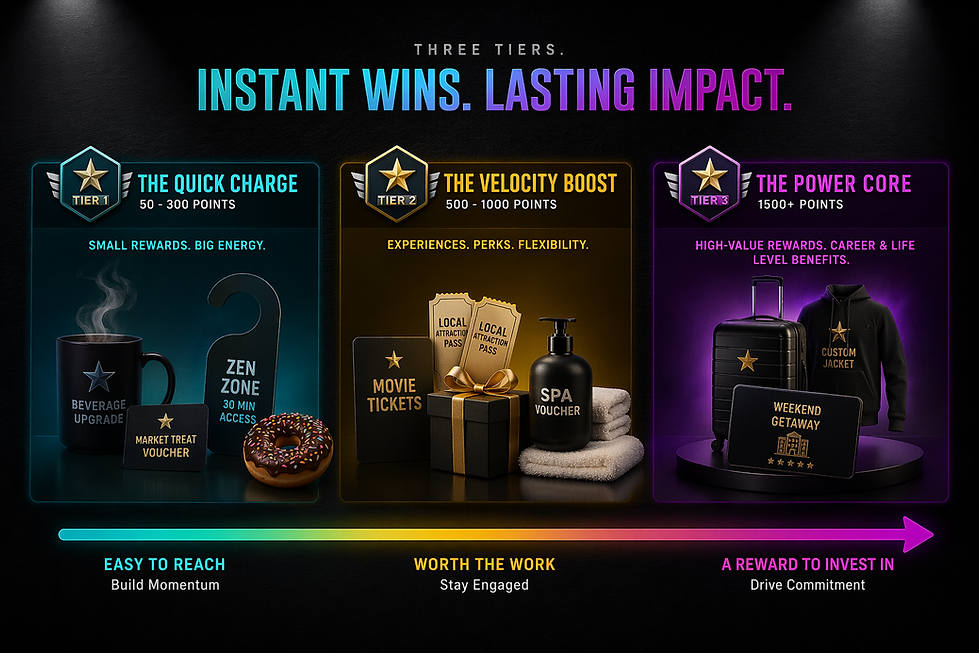
Points are redeemed quarterly through a tiered structure designed to balance immediacy with aspiration.
At the lower end...
there are small, accessible rewards; things that provide instant value with little to no cost to the operation.
At the higher end...
there are more meaningful incentives. Experiences. Flexibility. Items that require consistency over time.
The structure matters.
Because it creates two types of motivation at once:
Short-term participation.
Long-term investment
And importantly, the system doesn’t decide what people receive.
They do.
That autonomy removes a common point of friction:
recognition feels selective or uneven.
Instead, outcomes are directly tied to participation.
The system becomes fair by design.
Making It Sustainable
One of the immediate concerns with any reward-based system is cost.
That constraint was built into the structure from the beginning.
Lower-tier rewards are designed to use existing operational resources while higher-tier rewards are supported through a combination of fixed budgeting and local partnerships.
This introduces a different kind of value exchange.

This system was not introduced gradually.
It was designed, presented, and implemented within the first six months of joining the organization.
The initial proposal focused on a single idea: If the goal is to rebuild trust and engagement, the system cannot feel like it belongs to management.
It has to operate with transparency, consistency, and with visible commitment behind it.
Leadership alignment was secured early, and the full structure was built and launched on January 1, 2026.
The environment it launched into was not ideal...
A small team.
A slow winter season.
Limited budget.
Strict time constraints for any activity.
And still, the system began to take hold.
What changed?
The First 90 Days...

A small system | Real Results | Built to perform within constraints
The Hotel Hero Rewards Program is not a campaign or a short-term initiative.
It’s a structure that turns culture into something:
-
visible
-
measurable
-
repeatable
It can be adapted to larger teams through group-based models.
Expanded through stronger partnership ecosystems.
Refined through data over time.
And while it was developed within a hospitality environment, its core function applies anywhere that depends on
human interaction, collaboration, and shared accountability.
In environments with greater flexibility—expanded budgets, longer engagement windows, or operational autonomy—the system can extend further through enhanced rewards such as schedule flexibility, time-based incentives, and experiential benefits.
The structure remains the same.
Only the ceiling changes.
Closing Statement:
Engagement doesn’t improve because people are told to care more.
It improves when the system they operate in makes participation natural, visible, and worth sustaining.
This is what happens when that system is designed intentionally.